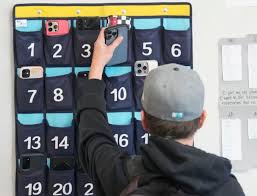
As announced during class meetings, the 2026-27 school year holds major changes regarding cell-phone use at GRHS. However, this policy change is not simply an independent school decision, but a response to statewide legislation.
The new bill (No. 3695), passed through NJ legislature, “Requires guidelines on student use of internet-enabled devices to be developed by DOE and policy to be adopted by the governing body of each public school.” However, the regulations established in this bill — which takes effect for the next full school year — are much more nuanced than this synopsis. First, the bill defines internet-enabled devices as “a smartphone, tablet, smartwatch, or other device capable of connecting to… content on the internet, including social media applications.” It then mandates that the Commissioner of Education develop guidelines (applicable to grades K-12) regulating the use of internet-enabled devices, which must be issued no later than 90 days after the passing of the bill.
However, the Commissioner of Education does not have free rein with these guidelines; the bill denotes exactly what is required within them. The policy must include guidelines differentiated for each age and grade level, and prohibit ALL non-academic use of internet-enabled devices on school grounds during the school day. Although this seems relatively impenetrable, there are exceptions. Accommodations necessary for students with IEP or 504 Plans must be made, in accordance with State and Federal regulations. During emergencies or perceived threats of danger, students’ use of cell phones is permitted as well. Furthermore, cell-phone use is permitted under explicit permission from an administrator, deemed necessary based on a student’s prescribed healthcare, or on a case-by-case basis where a student is serving as a caregiver for a family member.
The Commissioner’s guidelines must also list options a school may utilize for internet-enabled device storage, such as locked pouches and designated lockers. Concerningly, the guidelines also must explain how a BOE can establish network restrictions preventing social media use (blocking it via WiFi). Many stakeholders are mentioned as parties the Commissioner must consult. These include “the New Jersey Education Association, the American Federation of Teachers, the New Jersey School Boards Association…” etc. However, although the bill mentions a promotion of student learning and well-being and responsiveness to student needs, there is no mention of consulting NJ Students — the primary stakeholders to be affected by this new governance.
Even though studies have overwhelmingly shown that banning mobile phones increases academic focus and performance in schools, it is highly unlikely that this ban will be received well in GRHS, or NJ schools as a whole, for that matter. There may not be a “right” way to ban cell phones, but there are certainly wrong ways. Methods suggested in the bill, such as personal pouches (likely referring to the brand Yondr), are extremely expensive and economically infeasible for a school district such as Hackensack School District (recently found to be facing a self-inflicted financial crisis and $2 million deficit due to mismanagement). Furthermore, using restrictions such as Yondr and personal lockers is extremely restrictive and often looked down upon by students.
Thus, if future governance and policies enacted within the Commissioner’s guidelines, or even GR school policy takes into account student testimony and collaborate with high-schoolers to form a fair yet law-abiding ban on cell phones, solutions will likely see much more approval and efficiency.