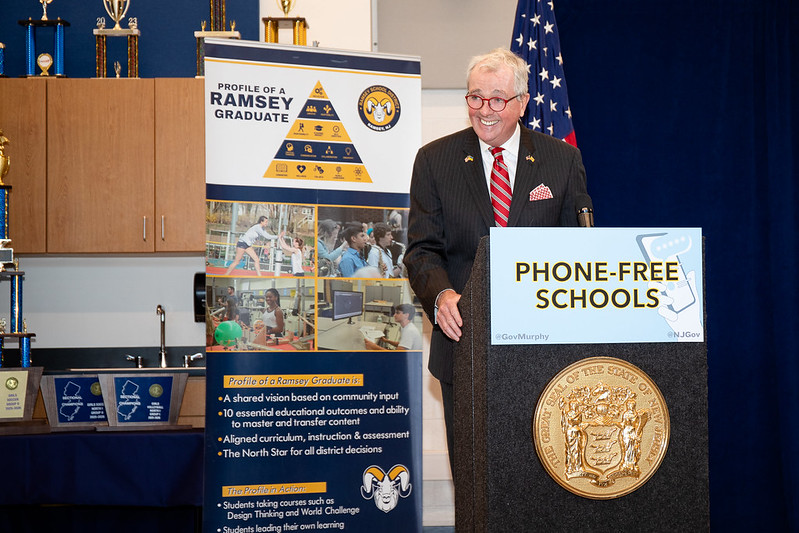
On Thursday, January 8, Governor Phil Murphy gave the final approval to a bill that will require all New Jersey public schools to adopt policies prohibiting cellphones from “bell-to-bell.”
New Jersey is not the first state to take such action—as of September 2025, thirty-four other states had already implemented either partial or total bans. Upon signing the bill, which passed with overwhelming bipartisan support, Governor Murphy stated, “I wish this ban had been in place a long time ago.”
But this doesn’t mean schools lacked cell phone policies until this time. The Ramsey School District, for example, has been leading the charge for over a year with its complete cell phone ban for students of all grade levels. The district received a $10k grant from the State Legislature as part of a state program to test out the effectiveness of phone ban strategies such as Yondr pouches, which lock students’ cellphones in small pouches throughout the day and cannot be opened until they leave.
According to a May 2025 faculty survey, the district’s policy showed notable positive results. As an acknowledgement of the success of Ramsey’s phone ban, Governor Murphy chose to finally sign the bill into law in their very high school. Massimo Randazzo, a senior and the student-body president at Ramsey High School, had the opportunity to introduce Governor Murphy before the bill signing. Although he had initial concerns with his school’s policy, he spoke about how he now appreciates it: “I assumed being separated from my phone would make the day more tense. Instead,” he said, “it created a break from nonstop notifications, group chats, and the pressure to always be available. The school day felt calmer and more manageable. That’s not to say everything was perfect.”
With these cellphone use guidelines officially written into state law, Governor Murphy says, “we are ensuring New Jersey schools are a place for learning and engagement, not distracting screens that detract from academic performance.” He hopes the bill will encourage students to socialize in their classrooms and hallways, not through a phone. “By getting rid of needless distractions,” he continued, “we are fundamentally changing our schools’ learning environments and encouraging our children to be more attentive and engaged during the school day.”
So when can we expect to see these new policy changes at Glen Ridge High School? And what will the change even look like? For all of the students who may be worried by the news of this monumental legislation (or the select few who are rejoicing), here’s everything you need to know about the bill:
It will go into effect for the 2026-27 school year.
The legislation requires that new policies be implemented by the start of the next school year. (Ha! The Class of 2026 got out just in time!)
Each school district has the authority to choose the scope of the ban.
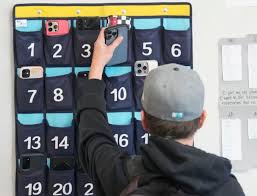
The bill does not require any specific method for enacting the ban, such as Ramsey’s Yondr pouches. Districts may choose a policy that they feel works best for their students, whether it goes as far as not letting students bring them to school or merely requiring students to leave them in their backpacks until the end of the day.
The only guideline that school districts must follow, according to the bill, is as follows: schools must “prohibit non-academic use of a cell phone or social media during classroom instruction.”
The terms of the ban may vary depending on grade level.
The bill gives schools the flexibility to carry out restrictions of varying intensity depending on the age of the students. As the policy currently exists at Glen Ridge High School, 7th or 8th-grade students may continue to face more severe phone restrictions than students in grades 9-12.
In essence, the Glen Ridge Board of Education can choose to adopt any number of policies that fit within the state’s regulations—whether this will be Yondr pouches, phone cubbies, or a continuation of the “off and away” policy, we’ll just have to wait and see.